




On February 8th, 2026, the NFL held its LX (60th) Super Bowl game in Santa Clara, California. For an opening celebration, Green Day, a famous radical rock band, sang a few snippets of their famous songs, such as “Good Riddance (Time of Your Life),” “Holiday,” “Boulevard of Broken Dreams,” and “American Idiot.” As it is every year, there is a more significant performance every fan waits for: the halftime show. This year’s performer was Puerto Rican (American) singer Bad Bunny. The entirety of Bad Bunny’s music is in Spanish, embracing and appreciating his Latin American roots.
Bunny, real name Benito Antonio Martínez Ocasio, was quick to refute and dismiss claims made by critics who disdained his native language sung during his performance. “People only have to worry about dancing. They don’t even have to learn Spanish,” Bunny said, a week before his performance in a public conference. “Better they learn to dance. There is no better dance than one that comes from the heart.”
Following his massive success at the Grammys, where he won Album of the Year, anticipation for Bunny’s performance skyrocketed, and it did not disappoint. The 13-minute performance was filled with symbolism and did not shy away from making any political statements.
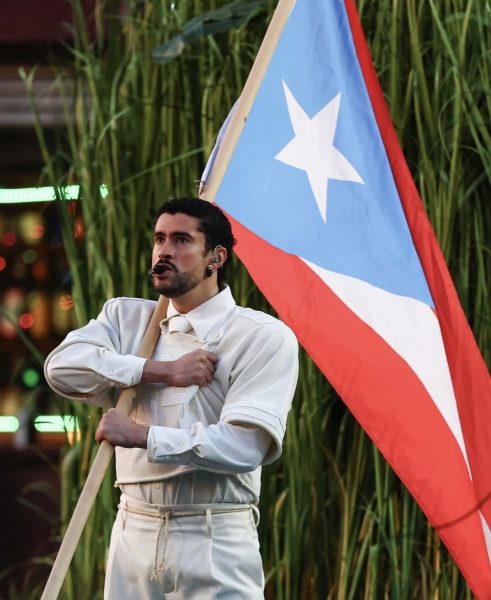
‘Tití Me Preguntó,’ which translates to “Titi asked me,” was the opening song to his performance. The beginning of the set starts with the camera showing people working in a sugarcane field while wearing pavas. Sugar cane fields, which have been the backbone of Puerto Rico’s economy for centuries, were heavily featured in his performance. The hats that the dancers were wearing are called pavas, and are a traditional hat worn by sugarcane cutters and other agricultural workers that is heavily associated with authentic Puerto Rican culture. All of these details are integral to his performance, which heavily represents and appreciates his birthplace in Puerto Rico.
The camera continued to follow Bunny around the synthetic field to different sets that represent Latin culture. As Bunny was walking, the first small set he encountered was a stand for ‘Coco frio,’ translating to “cold coconut” in English. Coconuts grow abundantly in Puerto Rico, with coconut palms being a common sight. He next comes across a group of older men playing dominoes and a nail technician doing a woman’s nails. Most notable of the small sets littered throughout the field were three girls stacking cement blocks, seemingly a direct callout to “building the wall” and the division going on in the United States today.
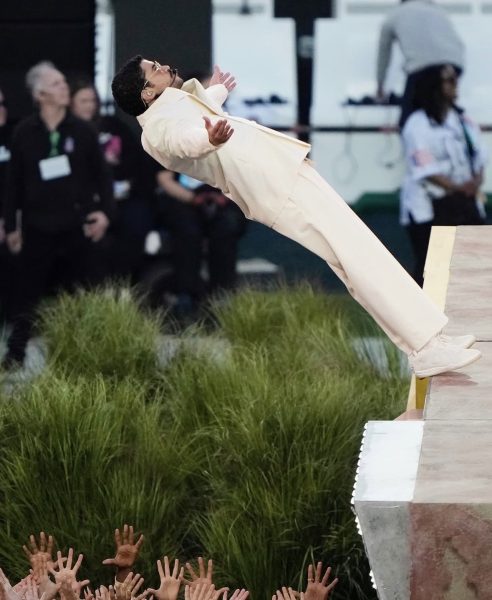
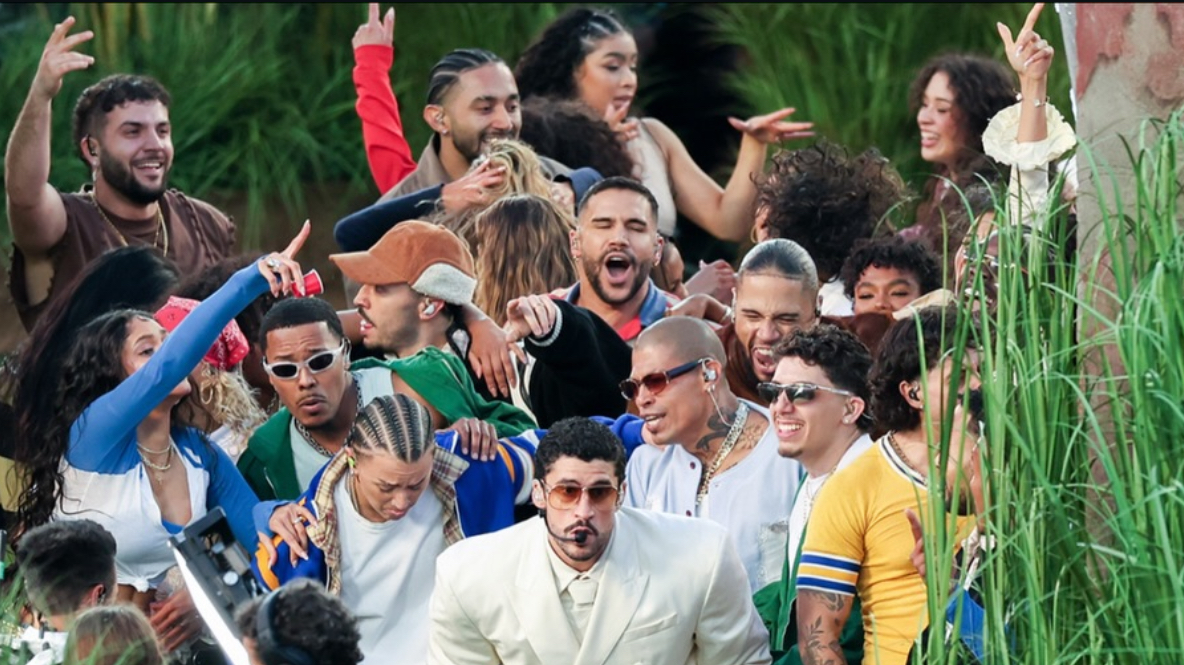
As Bunny makes his way out of the ‘field,’ he stumbles across a house party with a star-studded porch. Featured throughout the performance were numerous famous faces – such as Pedro Pascal, a Chilean American actor; Cardi B, a Black Latina singer and rapper; Young Miko, Puerto Rican LGBTQIA+ singer and rapper; Karol G, a Colombian urban pop singer; and Ricky Martin, an LGBTQIA+ Puerto Rican singer and actor. Young Miko, Ricky Martin, and Lady Gaga are members of the queer community and are quite open to their values. Bad Bunny is extremely open in advocating, including multiple gay and lesbian couples within his performance.
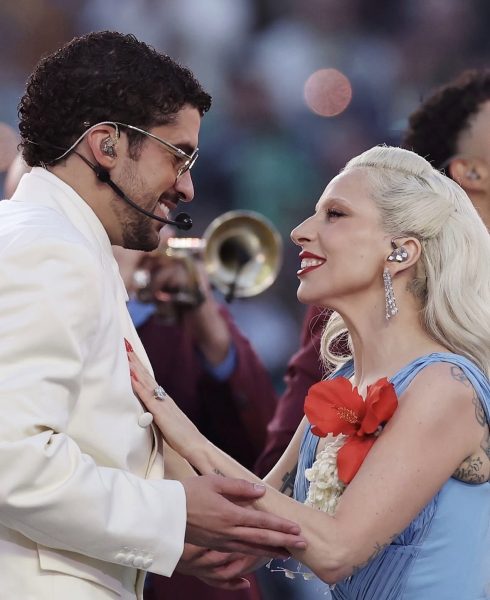
On a different note, Lady Gaga, a famous advocate for racial and gender equality. Lady Gaga played a salsa version of “Die with a Smile.” Countless dancers and bands join in the adjusted version of her original song featuring Bruno Mars (not at the Super Bowl), some couples were of the same sex. During this portion of the show, Gaga featured in a blue flowing dress with a red flower, this flower adorning her outfit was a “Flor de Maga,” the official flower of Puerto Rico. Although the flower is often mistaken for a hibiscus, it presents with vibrant reds and pinks, symbolizing the resilience, strength, and beauty of Puerto Rican people.
After the halftime show performance, Bad Bunny’s Spotify streams increase by 470% in the United States alone, his most listened song was “Yo Perre Sola,” increasing by 1,270%. This year’s show had a total of 135.4 million viewers, breaking the all-time record for halftime show viewers. Bad Bunny has always been an advocate for individuals of all colors and ideals, preaching that his music aims to unite communities through love and rhythm rather than being led by the language. According to “HOT97” 25% of music listeners 13 and above listen to Spanish music despite the lower demographics of Latinos in the U.S. and Puerto Rican music holds 30% of Spanish music listening charts.
Halfway through Bad Bunny’s performance he stops at “Toñita’s House,” the founder of the Caribbean Social Club in Williamsburg, New York City. The club started as a member only hangout for the community, turning to a full-on bar and restaurant with Toñita as the matriarch of the establishment. Bunny had given the establishment a direct shout out alongside taking a shot from Toñita herself.
Following the big block party, the camera pans over to a Latin family watching Bad Bunny accept his Grammy on the TV. Bunny then gives comes in frame and hands his Grammy to the little boy. Although many people thought that the little boy was Liam Conejo Ramos, a 5-year-old that was detained by ICE in Minneapolis, it was not. The boy was a child actor from Costa Mesa, California named Lincoln Fox Ramadan.
About three quarters of the way through his performance, Bunny shifted his focus back to the field where there were stylized electrical poles. At this time, he started singing his song “El Apagón,” which translates to “The Blackout.” This song is a protest song against Puerto Rico’s poor infrastructure failures following Hurricane Maria.
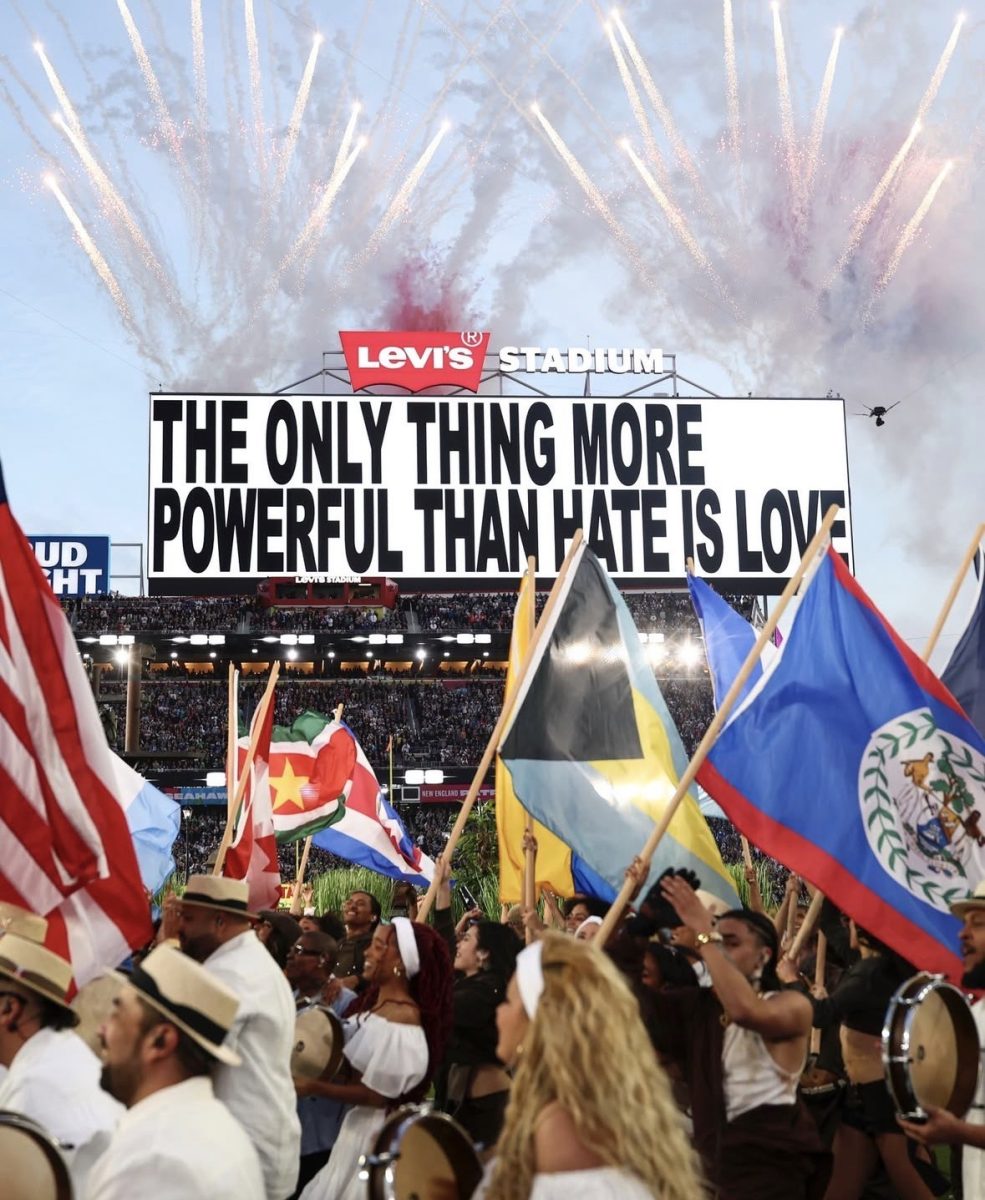
By the end of Bad Bunny’s performance, he was holding a football reading “Together, we are America” and stood among the numerous singers, dancers, and actors who were a part of his performance; as well as the large football screen behind the finale of NFL LX read: “The Only Thing More Powerful Than Hate is Love.” As a final hurrah, Benito shouts out, “God Bless America,” and names every country throughout North, Central, and South America to acknowledge the strength and unity rooted in love and respect. Bunny became a symbol of a nation’s intense culture war after naming American countries: Chile, Argentina, Uruguay, Paraguay, Bolivia, Peru, Ecuador, Brazil, Colombia, Venezuela, Guyana, Panama, Costa Rica, Nicaragua, Honduras, El Salvador, Guatemala, Mexico, Cuba, República Dominicana, Jamaica, Haiti, Antilles, United States, Canada, and my motherland, mi patria, Puerto Rico.” Bad Bunny did not speak to wedge a divide between the already delicate social structure but rather wanted to remind the countries that all the Americas are loved and valued. He wanted to represent unity in a time of cultural turmoil.